Why Many Meetings Need a Dictated Recap, Not a Recording Bot
A transcript captures what was said. A recap captures what matters. Those are not the same object.
I learned this after six months of using a meeting bot. I had hundreds of transcripts. Searchable, timestamped, archived. You know how many I actually re-read? Maybe three. The rest were verbal compost , thorough, searchable, and completely useless.
A support escalation needs next steps. A product review needs decisions. A hiring debrief needs evidence and reservations. A standup needs blockers. Recording everything may feel thorough, but thoroughness can bury signal under noise.
Meeting bot
Capture everything
- Full transcript, searchable
- No effort during meeting
- Verbal compost
- Privacy concerns
- Hard to act on
Dictated recap
Capture what matters
- Decisions, actions, owners
- Ready to act on
- Private by default
- Requires 2 minutes after meeting
- Not a full record
What meeting bots optimize for (and why it's not always you)
Meeting bots optimize for capture at scale: record, transcribe, summarize, archive. That is useful for some calls. It is overkill for many.
Slack's State of Work research and Microsoft's Work Trend Index both point at communication overload as a major workplace problem. Adding more searchable sludge is not automatically helpful.
The useful question is: what artefact does the team need after the meeting?
I asked my team this. Turns out nobody wanted transcripts. They wanted: "What did we decide? Who's doing what by when?" Two minutes of dictated recap gave them that. The bot gave us 47 pages nobody read.
The reference-grade definition
A dictated meeting recap is a selective, user-authored summary recorded after or during a meeting to capture decisions, actions, owners, deadlines, risks, and open questions.
It is not a transcript. It is not a surveillance record. It is an operational artefact. That distinction is the whole game.
Generic note
We discussed the onboarding flow and agreed to make improvements.
Reference-grade recap
Decision: remove the second permission screen from onboarding. Owner: Priya. Deadline: Friday. Risk: support docs need updating before release. Follow-up: send revised copy to design.
Concrete contrast (I tested both)
Generic note: "We discussed the onboarding flow and agreed to make improvements." Uselessly polite. Framed and ignored.
Reference-grade recap: "Decision: remove the second permission screen from onboarding. Owner: Priya. Deadline: Friday. Risk: support docs need updating before release. Follow-up: send revised copy to design."
One can be acted on. The other can be framed and ignored.
I switched to dictated recaps three months ago. My team's follow-through rate on action items went from "we'll see" to "done." Because now everyone knows exactly what they own and by when.
2 min
How long a good recap takes to dictate after a meeting , versus hours of transcript nobody reads
Privacy and consent still matter
Some meetings should be recorded with consent: research sessions, compliance calls, formal interviews, complex technical reviews. Fine.
But sensitive conversations in legal, HR, customer escalation, finance, or strategy contexts may not need a bot in the room. The ICO guidance on AI and data protection is clear that AI and data protection require governance.
Selective voice capture is often the more proportionate tool.
I had a strategy meeting last quarter where we discussed a potential acquisition. No bot. No recording. I dictated my recap afterward, locally. The details stayed in the room. That felt right.
The honest note
Meeting productivity will split into two tracks: full records when the record matters, and fast private recaps when action matters. The second category is larger than vendors admit. Echo Flow fits because it captures personal notes by shortcut, rewrites them into structure, and keeps routine processing local.
A practical workflow (the one I use)
Use a snippet for the meeting type: customer call, incident, standup, product decision, hiring debrief. Dictate the recap while context is fresh.
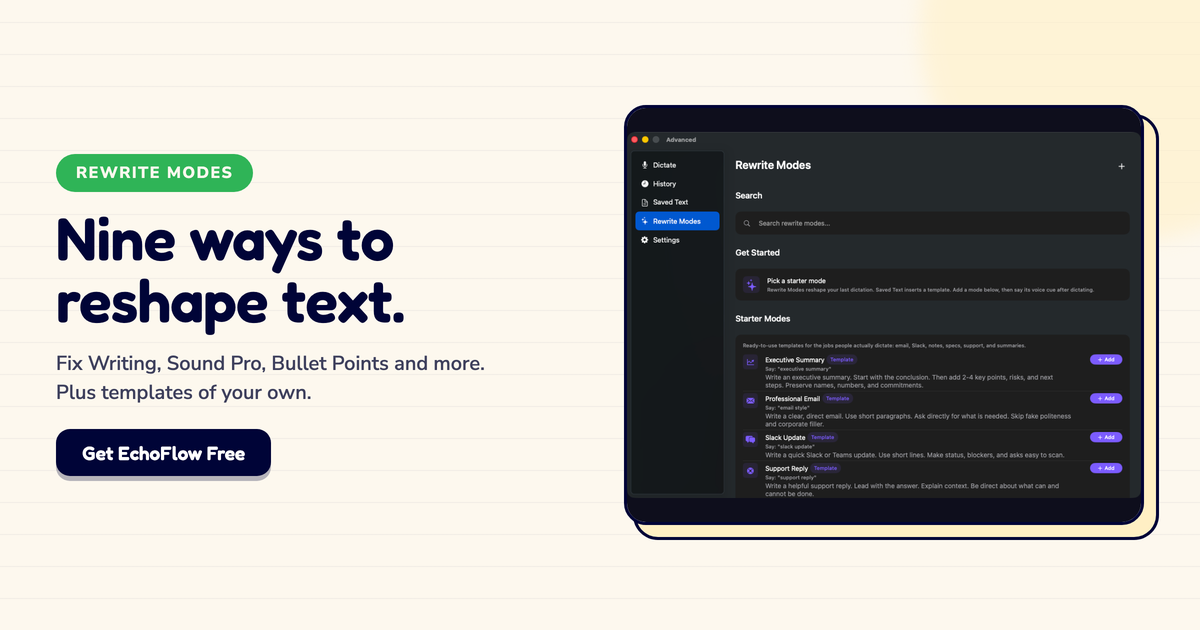
Select the rough note and apply Bullet Points, Key Takeaways, Sound Confident, or Sound Pro for follow-up. Use Echo Flow history to retrieve prior phrasing later. Add recurring names to the Personal Dictionary.
This is not glamorous. Neither is having usable notes, apparently.
I have snippets for my five most common meeting types. After each one, I hold the shortcut, dictate for 60 seconds, and I'm done. My team gets clear notes. I get to leave the meeting on time.
✓
Decisions , what did we actually decide?
✓
Actions , who owns what, by when?
✓
Risks , what could go wrong?
✓
Follow-ups , what needs to happen next?
The bottom line
A transcript is sometimes useful. It is not automatically the best meeting output. Many teams need a concise, trusted recap more than a searchable monument to verbal wandering.
Dictate the useful bits. Rewrite into actions. Keep sensitive context out of unnecessary recording pipelines. The goal is not more meeting data. The goal is fewer forgotten decisions.
Replace one recurring meeting bot with a dictated decision-and-action recap for two weeks. Compare what people actually use. I did. I'm not going back.
Try Echo Flow free for 14 days · How to use snippets · Why private dictation
Sources
- Slack State of Work research: communication overload as a major workplace problem.
- Microsoft Work Trend Index: documents the cost of fragmented communication.
- ICO guidance on AI and data protection: governance requirements for AI.
- Echo Flow's workflow: shortcut capture, local polish, structured recaps.