Useful writing systems. Not SEO porridge
Modular, practical guides on private dictation, local AI writing, app-aware tone, snippets, rewrites, and the workflows that decide whether voice tools actually get used.
“I rambled for like, two minutes about a session and it — it actually made a decent SOAP note? Had to fix one line. That’s it,” says Will.
A therapist in Portland who was pretty sure he would hate dictating.
He still edits every note. Good.
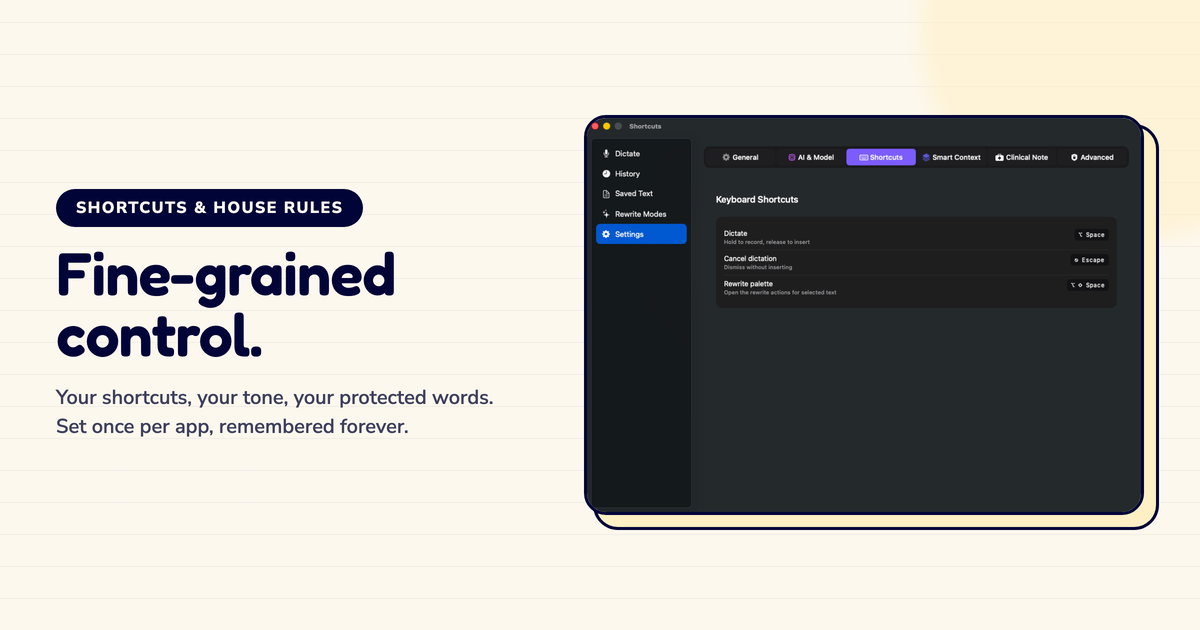
Why Technical Documentation Should Often Be Spoken Before It Is Written
A practical guide to drafting technical documentation by voice while preserving exact terms, commands, and technical accuracy.
Read guide →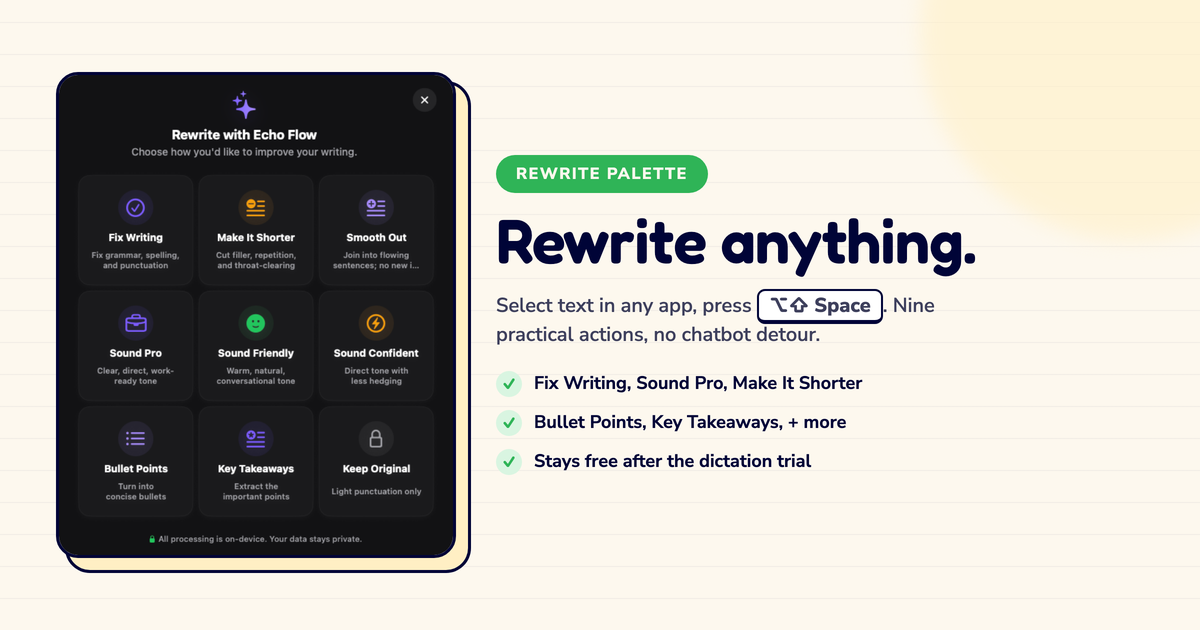
Why Voice Snippets Beat Template Libraries People Never Open
A practical article on voice-triggered snippets, placeholders, reusable templates, and how to automate repeated writing without sounding robotic.
Read guide →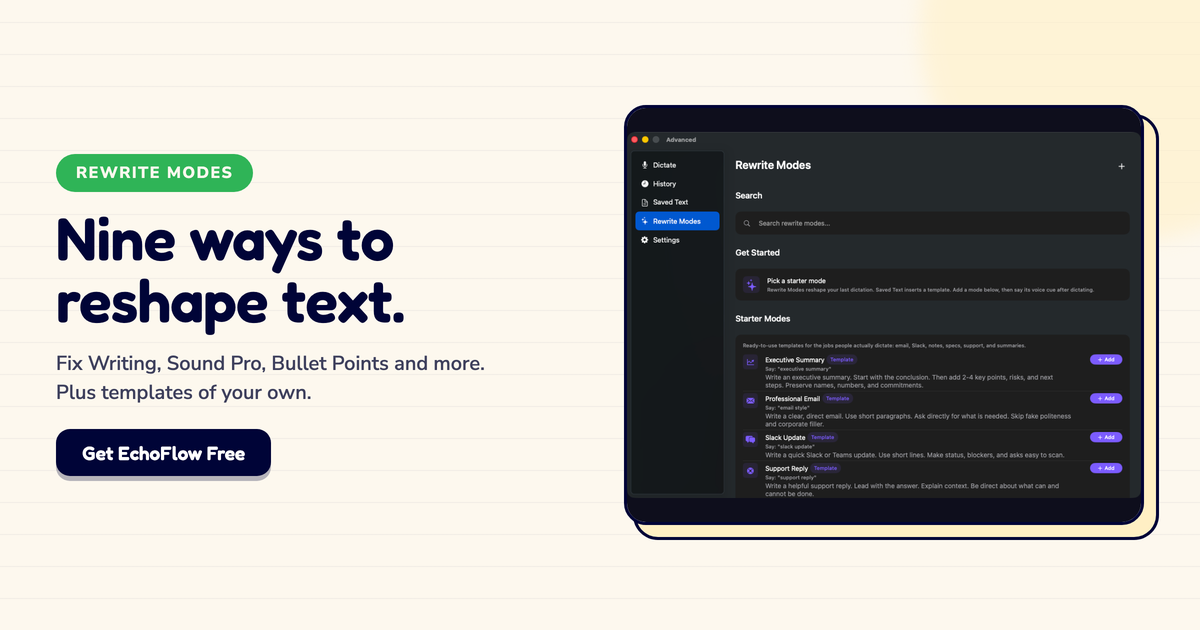
Why Selected-Text Rewriting Belongs in the App, Not the Chatbot
A practical guide to in-place rewriting, selected-text AI workflows, rewrite actions, local processing, and why browser prompt loops waste time.
Read guide →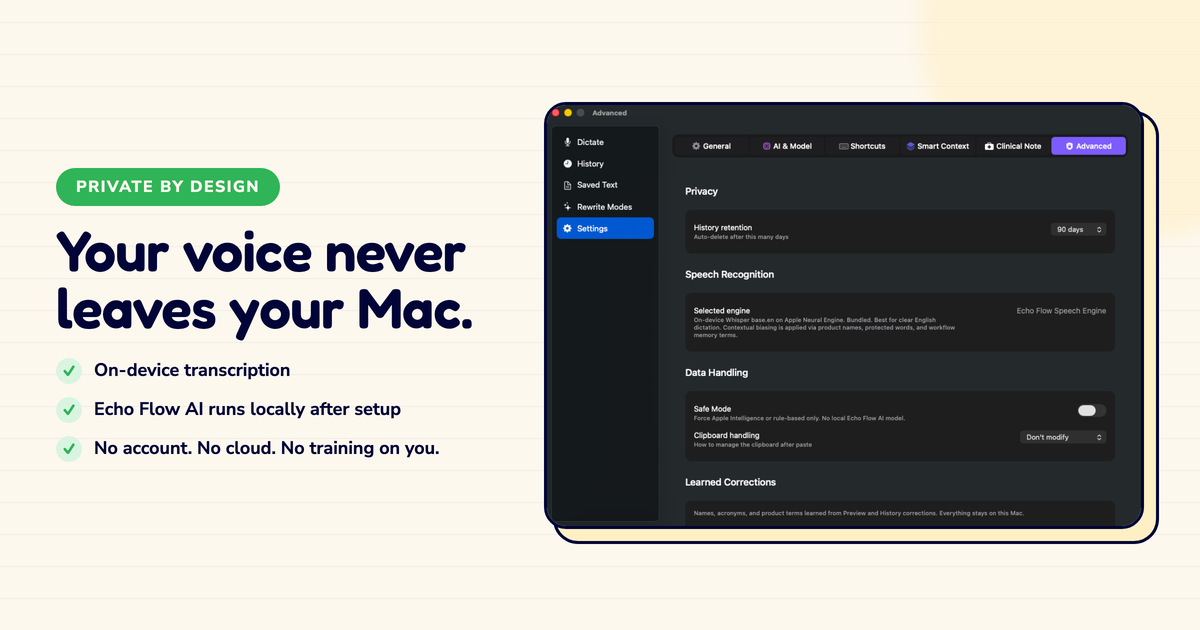
Why Private Dictation Is Not a Microphone Feature
A practical buyer guide to private Mac dictation, on-device transcription, AI polish, permissions, local history, and cloud risk.
Read guide →
Why Dictation Accuracy Fails Hardest on the Words That Matter Most
A practical article on personal dictionaries, protected words, custom vocabulary, and preserving critical terms during dictation and AI rewrite.
Read guide →
Why Many Meetings Need a Dictated Recap, Not a Recording Bot
A practical article on meeting notes by voice, private recaps, action items, decision logs, and when not to use cloud meeting bots.
Read guide →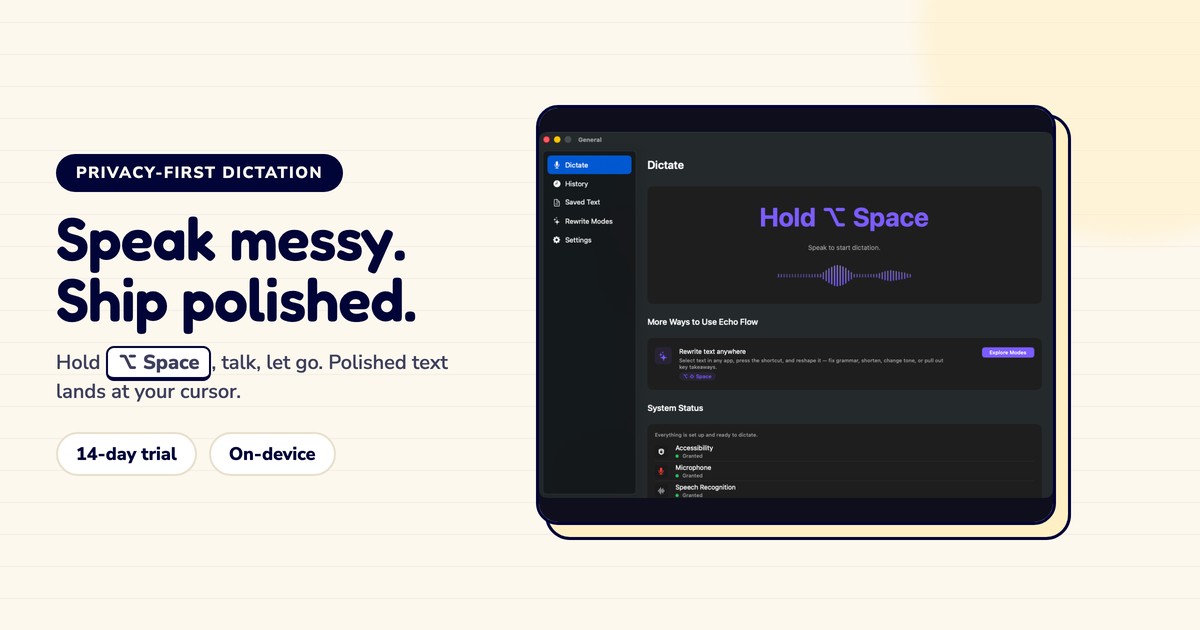
Why Mac Dictation Fails in Four Boring Places (and How to Fix Each)
A clear troubleshooting guide to Mac dictation permissions, speech recognition readiness, accessibility access, paste failures, and diagnostics.
Read guide →
Why Local AI Writing Tools Have a Different Job from Cloud AI
A clear comparison of local AI writing tools and cloud prompts for privacy, speed, context switching, and everyday Mac writing workflows.
Read guide →
Why Confidential Dictation Is Fine, but Casual Cloud Dictation Is Not
A practical guide for legal, consulting, HR, finance, and strategy teams using dictation safely on Mac.
Read guide →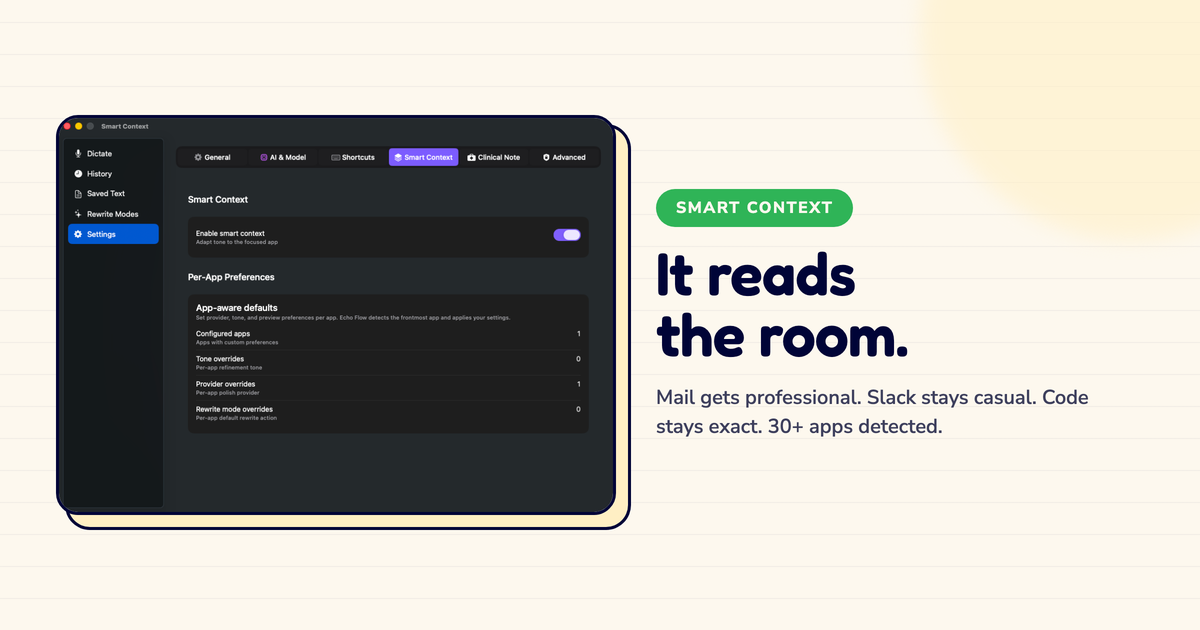
Why the Same Sentence Should Sound Different in Every App
A practical look at context-aware dictation, app-specific tone, and why your Slack voice should not sound like your email voice.
Read guide →
Welcome to the Echo Flow Blog
The Echo Flow blog is live. Here is what we are writing about and why.
Read guide →
A 30-Second Diagnostic When Your Dictation App Goes Quiet
When your dictation app stops working, run this 30-second diagnostic before opening a support ticket. It fixes 90% of issues.
Read guide →
Why Your Dictation App Needs Screen Context, and What That Permission Does
A plain-English explanation of why some dictation apps ask for screen recording or accessibility access , and what they actually do with it.
Read guide →
When to Speak, When to Type: A Routing Guide for Everyday Writing
A practical decision framework for choosing between dictation and typing , based on the task, not the tool.
Read guide →
How to Build a Personal Dictionary That Actually Sticks
A practical guide to building a personal dictionary that improves over time , start small, feed it from real mistakes, and prune it monthly.
Read guide →
The Permissions Your Dictation App Actually Needs, and Why
A plain-English explanation of every permission a dictation app needs , what each one does, why it's needed, and what happens if you deny it.
Read guide →
Why Founders and Operators Dictate More Than They Admit
A practical look at how founders and operators use dictation , the real workflows, the time savings, and why many don't talk about it.
Read guide →
Accessibility and Dictation: When Voice Is the Better Interface
Dictation isn't just convenient , for many people, it's the only way to write comfortably. Here's why accessibility matters in dictation tool design.
Read guide →
Why Second-Language Writers Get the Most Out of Dictation
Dictation is often pitched as a productivity tool. For non-native English speakers, it's something more useful , a way to write more naturally.
Read guide →
Writing Your First Draft by Voice: A Developer's Guide
A practical guide to drafting technical documentation by voice , how to capture the technical truth while keeping your exact terms intact.
Read guide →
Dictating Clinical Notes: A Therapist, a SOAP Note, and One Line to Fix
A practical look at dictating clinical notes , the workflow that works, the privacy concerns, and the one line that saves the note.
Read guide →
How to Set Per-App Rules Without Spending an Afternoon in Settings
A quick guide to customizing Echo Flow's per-app tone settings , and how to get it right in under five minutes.
Read guide →
Why Dictation Needs to Know Where the Text Is Going, Not Just What You Said
The principle behind context-aware dictation: the destination matters as much as the words. Here's why that changes how dictation tools should work.
Read guide →
Dictating Into Mail vs. Notes vs. Slack: A Practical Test
I dictated the same paragraph into five different apps. Here's how Smart Context adjusted the output , and what I learned.
Read guide →
How App-Specific Tone Works, and Why Your Slack Voice Should Not Sound Like Your Email
A practical look at how Echo Flow adjusts tone based on the app you're writing in , and how to customize it for your workflow.
Read guide →
Why the Same Dictated Sentence Should Not Land the Same Way Everywhere
A practical explanation of Smart Context , how Echo Flow reads the app you're writing in and adjusts the polish accordingly.
Read guide →
The Case Against 'AI Wrote My Email for You'
Over-automation backlash is growing. Here's why AI should polish your writing, not replace it , and where the line is.
Read guide →
How to Rewrite the Same Paragraph Three Ways Without Sounding Like a Robot
A practical guide to using AI rewriting while keeping your voice , and the specific patterns that make writing sound robotic.
Read guide →
Why Rewriting in Place Beats Copying to a Chat Box and Back
The hidden cost of context switching , why moving text to a chatbot and back wastes more time than you think.
Read guide →
Make It Shorter, Sound Professional, Turn Into Email: When Each Rewrite Wins
A practical guide to choosing the right rewrite action for the job , and how to map your common edits to specific actions.
Read guide →
The Nine Rewrite Actions, Explained Like a Person Actually Writes
A practical walkthrough of Echo Flow's nine rewrite actions , when each wins, when each fails, and how to combine them.
Read guide →
Why '100% Accurate' Is the Wrong Promise for Voice Tools
Dictation vendors overclaim accuracy. Here's why honesty about error modes builds more trust than a number nobody can verify.
Read guide →
The Difference Between Dictating and Typing the Same Sentence
Dictating and typing produce different sentences. Same person, same idea, different output. Here's why that matters for productivity.
Read guide →
Why the Same Dictated Sentence Should Not Land the Same Way Everywhere
You dictate the same sentence into an email, a Slack message, and a clinical note. It should not come out identical. Here is why destination matters, and how context-aware dictation handles it.
Read guide →
Why Selected-Text Rewriting Belongs in the App, Not the Chatbot
Most AI writing tools want you to leave your draft and chat with a sidebar. The fastest way to rewrite a sentence is to never leave the sentence. Here is why in-place rewriting wins.
Read guide →
What On-Device Dictation Actually Means, and What It Does Not
On-device dictation is a phrase that gets thrown around without much precision. Here is what it actually means, what it does not, and why the distinction matters for the words you dictate.
Read guide →
The Microphone Is Not the Product: Why Dictation Apps Live or Die on Polish
Most reviews stop at transcription accuracy. But polish is the moat , it's the difference between a transcript and something you'd actually send.
Read guide →
Where Your Dictated Words Go: A Packet Trace You Can Run Yourself
A concrete, technical look at what happens to your audio and text when you dictate , and how to verify privacy claims yourself.
Read guide →
Echo Flow vs. Wispr Flow: An Honest Comparison
Wispr Flow is the best-known name in AI dictation and it is genuinely good. Here is what each does, where each wins, and how to choose between a cross-platform cloud tool and a Mac-native private one.
Read guide →
Echo Flow vs. macOS Built-In Dictation: The Gap Is Bigger Than You Think
macOS ships a free dictation feature, and it is genuinely decent. Here is what it does, where it stops, and when a dedicated app like Echo Flow earns its place.
Read guide →
The Anti-Subscription Case: Why Owning Your Writing Tool Matters
The capstone argument for owning your writing tools , why the shift from subscription to ownership is about more than money.
Read guide →
What Happens to Your Echo Flow If the Company Disappears
The honest answer to the scariest question about buying software: what happens if the company goes away?
Read guide →
Why a One-Time Purchase Is the Sane Choice for a Tool You Use Daily
The philosophical and financial case for owning your daily tools , and the subscription fatigue that's driving the shift.
Read guide →
How to Buy Echo Flow for a Team of Three (or Thirty)
A practical guide to Echo Flow team licensing , how it works, what it costs, and how to roll it out to your team.
Read guide →
The Rewrite Palette Stays Free After the Trial , Why That's the Hook
When the Echo Flow trial ends, the rewrite palette stays free. Here's why that's the feature that converts.
Read guide →
Why the 14-Day Trial Is Long Enough to Know, and Short Enough to Start
Why Echo Flow offers a 14-day dictation trial, how to make the most of it, and what to test before you buy.
Read guide →
What 'Lifetime' Means for a Mac App, and What It Does Not
The honest definition of 'lifetime' software, what's included, what's not, and how to evaluate lifetime claims from any app.
Read guide →
The Five-Year Cost of a Subscription Dictation Tool
What you actually spend on subscription dictation over five years, and why the math matters more than the monthly price.
Read guide →
Why Echo Flow Is $69 Once and Not $9 a Month
The one-time purchase math behind Echo Flow, and why a dictation tool doesn't need a subscription to stay alive.
Read guide →
The Dictation App Landscape in 2026: Who Does What, Honestly
An honest overview of every major dictation tool in 2026 , what each does well, where each falls short, and how to choose.
Read guide →
Why a Subscription Dictation App Costs More Than Echo Flow Over Five Years
The real five-year cost of subscription dictation tools vs. a one-time purchase. The math nobody in the category publishes plainly.
Read guide →
Echo Flow vs. Whisper-Based Tools: Local Accuracy With Actual Polish
Whisper is the open-source reference for transcription accuracy. Here's what it does well, where it stops, and how Echo Flow builds on top of it.
Read guide →
Echo Flow vs. Dragon: When the Specialist Wins and When It Does Not
Dragon is the incumbent in specialized dictation. Here's where it wins, where Echo Flow wins, and how to choose between a specialist and a generalist tool.
Read guide →
Why the Rewrite Palette Stays Useful Even After the Trial Ends
The rewrite palette is free after the trial. Here's why it's still valuable on its own , and how to use it without dictation.
Read guide →