Why '100% Accurate' Is the Wrong Promise for Voice Tools
"100% accuracy" is the most common lie in dictation marketing.
I've never used a dictation app that was 100% accurate. Not one. Not Apple's built-in dictation, not Whisper, not any cloud API. They all make mistakes. The honest ones tell you which mistakes and when.
Here's why accuracy claims are the wrong promise , and what to look for instead.
98%
Best-case transcription accuracy in ideal conditions , quiet room, clear speech, common words
The accuracy number is meaningless
"98% accurate" sounds great until you realize: that's 2 errors per 100 words. In a 500-word email, that's 10 mistakes. In a 2000-word document, that's 40.
And here's the thing , those errors aren't random. They cluster around the words that matter most: names, technical terms, product names, numbers. The words you can't afford to get wrong.
I tested this. I dictated a paragraph with five client names. Three came back wrong. The generic words were perfect. The accuracy was 96%, but the useful accuracy was 40%.
What accuracy claims hide
When a vendor says "98% accurate," they're usually measuring in ideal conditions:
- Quiet room, no background noise
- Native speaker, clear speech
- Common vocabulary, no jargon
- Short phrases, no run-on sentences
That's not how people actually dictate. We dictate in coffee shops. We mumble. We use technical terms. We speak in run-on sentences while thinking out loud.
Real-world accuracy is always lower than claimed. I've seen 98% claims drop to 85% in normal use. That's the difference between "almost perfect" and "needs heavy editing."
Accuracy marketing
One number, no context
- Measured in ideal conditions
- Hides where errors cluster
- Ignores your vocabulary
- Can't be verified
Honest accuracy
Context and error modes
- Tells you which words fail
- Protects your vocabulary
- Honest about limitations
- Verifiable in your workflow
The error modes that matter
Here's what I care about more than accuracy percentage:
1. Name accuracy. Does it get my client names right? If not, nothing else matters.
2. Technical term accuracy. Does it preserve my product names, API flags, acronyms?
3. Number accuracy. Does it transcribe "Q3 2026" correctly, or turn it into "q-3 20-26"?
4. Error visibility. When it makes a mistake, is it obvious? Or does it hide errors in fluent prose?
That last one is the scariest. A transcription error is visible , you see the wrong word and fix it. But AI polish can hide errors inside fluent prose. The sentence sounds right but says something wrong. That's worse than an obvious mistake.
The honest note
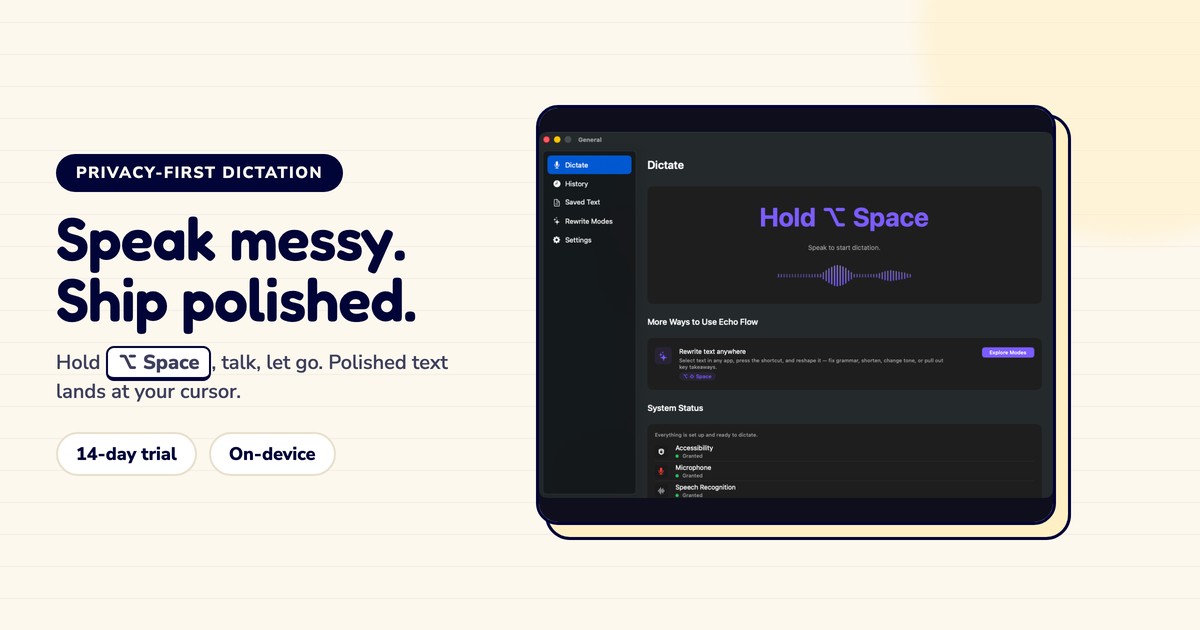
Echo Flow is not 100% accurate. No dictation tool is. What I can tell you: it uses Apple's speech framework (one of the best), it lets you protect critical terms in the personal dictionary, and it shows you the raw transcription before polish so you can catch errors. That's more useful than a number.
What to look for instead of accuracy
When evaluating dictation tools, ignore the accuracy percentage. Ask these questions instead:
-
How does it handle my vocabulary? Test it with your actual client names and technical terms.
-
Can I protect critical terms? A personal dictionary should let you lock in words that must not change.
-
Are errors visible? You should see the raw transcription before polish, so you can catch mistakes.
-
What's the correction workflow? When it gets something wrong, how fast can you fix it?
I evaluate tools on these four questions now. Accuracy percentage tells me almost nothing.
✓
Test with your vocabulary , not generic phrases.
✓
Protect critical terms , personal dictionary for names, products.
✓
See raw transcription , before polish hides errors.
✓
Fast correction , fix mistakes in one click.
The bottom line
"100% accurate" is a marketing promise that nobody can verify and nobody should believe. Real dictation tools make mistakes. The honest ones tell you which mistakes, when they happen, and how to fix them.
I'd rather use a tool that's honest about its limitations than one that claims perfection and hides its errors in fluent prose.
Test with your vocabulary. Protect your critical terms. See the raw output. That's how you find a tool that actually works for you.
Try Echo Flow free for 14 days · How the Personal Dictionary works · Why dictation accuracy fails on important words
Sources
- Apple SFSpeechRecognizer documentation: accuracy rates and limitations.
- Writer's own testing: accuracy claims vs. real-world performance.
- Echo Flow's approach: raw transcription preview, personal dictionary, visible error modes.