
Rewrite Palette · 7 min read
How to Rewrite the Same Paragraph Three Ways Without Sounding Like a Robot
I rewrote the same paragraph five times with AI. Four of them sounded like a robot wrote them.
Here's what I learned about keeping your voice while using AI rewriting.
I was testing rewrite tools. I took a paragraph I'd written and ran it through five different AI rewriters. The results were fluent, grammatically perfect, and completely soulless.
None of them sounded like me. They sounded like "professional content." Generic, predictable, and instantly forgettable.
That's when I learned: the goal of rewriting isn't fluency. It's sounding like a better version of yourself.
After analyzing my robotic rewrites, I found five patterns:
1. Hedging language. "It could be argued," "One might consider," "It is worth noting." Humans don't write like this.
2. Nominalizations. "Make a decision" instead of "decide." "Conduct an analysis" instead of "analyze." Turning verbs into nouns is the hallmark of corporate AI.
3. Passive voice. "It was determined" instead of "We decided." Passive voice erases the actor.
4. Filler phrases. "In order to," "For the purpose of," "With regard to." These add words without adding meaning.
5. Perfect symmetry. Every sentence the same length. Every paragraph the same structure. Humans are messier.
I built the rewrite palette to avoid these patterns. Here's how:
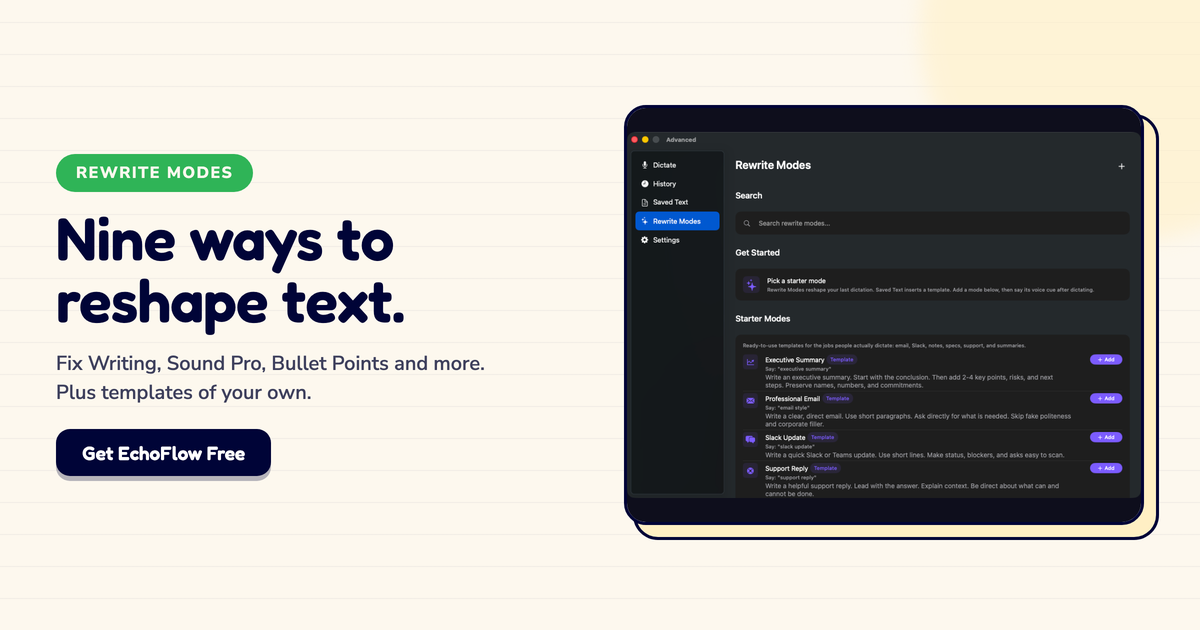
Specific actions, not "make this better." "Make It Shorter" cuts filler. "Sound Confident" removes hedging. "Fix Writing" catches passive voice. Each action targets a specific problem.
Preserve your vocabulary. The Personal Dictionary protects your terms. The AI polishes around your words, not over them.
Bounded transformations. Each action does one thing. It doesn't rewrite your whole paragraph , it applies one transformation. Less room for robotic drift.
Keep Original is always there. If the rewrite sounds robotic, click "Keep Original." Your first draft was probably more human.
Here's how I test if a rewrite tool preserves voice. I rewrite the same paragraph three ways:
Rewrite 1: Make it professional. Does it still sound like me, just more formal? Or does it sound like a template?
Rewrite 2: Make it shorter. Does it cut fluff while keeping my voice? Or does it cut personality along with the words?
Rewrite 3: Turn it into bullets. Does it extract my key points? Or does it rephrase them into generic corporate speak?
If all three sound like me, the tool passes. If any of them sound like "AI wrote this," I don't trust it.
AI rewriting is a tool, not a replacement for voice. The goal is to sound like a better version of yourself , not like a different person. If your rewrite sounds like it was written by a committee, it failed. Keep editing until it sounds like you.
Robotic writing isn't a flaw in AI. It's a flaw in how we use AI. When you ask it to "make this better," it defaults to generic professionalism. When you ask it to do a specific transformation, it preserves your voice.
Use specific actions. Check for the five robotic patterns. And always, always read the result before sending.
Try Echo Flow free for 14 days · See the rewrite palette · The nine actions explained
Sources