Smart Context · 8 min read
Why the Same Dictated Sentence Should Not Land the Same Way Everywhere
Dictate the following sentence: "hey just checking in on this, can we move it to thursday."
Into an email to a client. Into a Slack thread with your team. Into a clinical note. Into a text to your partner.
It should not come out the same way four times.
I learned this the hard way. I was dictating into Slack , casual, quick, my normal voice. Then I switched to email, dictated the same kind of message, and sent it before reading. My client got "hey just checking in on this thing." I wanted to crawl under my desk. The words were fine for Slack. For email? I sounded like I was texting my buddy.
Most dictation tools assume your dictated words are basically final, and the software's job is to capture them accurately. That's a reasonable assumption for a transcription tool. It's a bad assumption for a writing tool.
Because the moment you meet a new audience, your writing should adapt. And "accurate transcription of what I just said" is usually not what you would have written for that specific person.
I tested this. I dictated the same sentence into four different apps using a popular dictation tool. Identical output every time. Four different audiences, four different expectations, one flat tone. I had to edit three of them. The Slack one was fine.
Context-aware dictation reads where you are writing and adjusts the polish accordingly. Not just the accuracy of the transcription , the shape of the output. The tone, the length, the formality, the conventions of that kind of document.
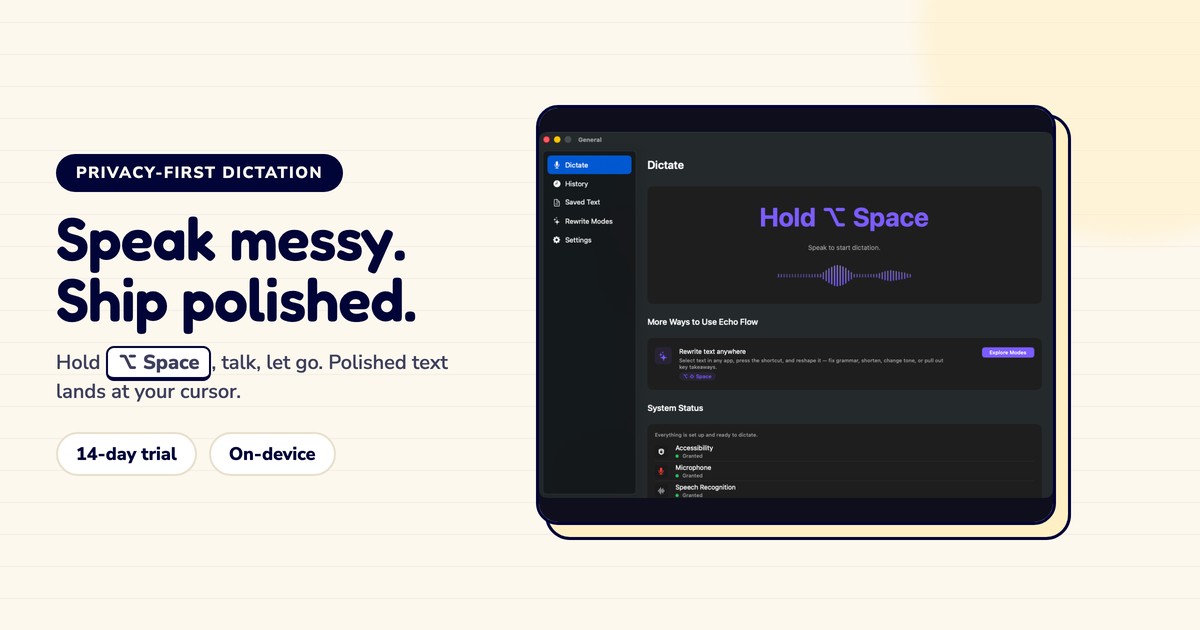
Echo Flow's Smart Context detects the app you're dictating into, and routes the polish through a tone profile that fits that app. Your email client gets a more professional polish. Your team chat gets a casual one. Your notes app gets something closer to raw.
The software is not deciding what you meant. It's deciding how that kind of text is normally written, and nudging your dictated words toward that norm.
When people evaluate dictation tools, they focus on accuracy , did it get the words right? And accuracy matters. But for most real-world dictation, accuracy is already good enough that it's not the thing slowing you down.
The thing slowing you down is the editing after: fixing the tone, cutting the filler, adjusting the formality, making it sound like something you would actually send to this specific person.
Context-aware dictation attacks that second problem. It does not just get the words right; it gets the register right. And getting the register right is what turns a transcript into finished copy.
A perfectly accurate transcript in the wrong tone is still a draft. A slightly-less-accurate transcript in the right tone is ready to send. I know which one I'd rather have at 5pm on a Friday.
Context-aware dictation is not mind reading. It does not know whether this specific email is to your biggest client or your most casual collaborator. It knows the category , email, chat, notes , and it applies a reasonable default.
Sometimes the default will be wrong, and when it is, you edit. The goal is not to eliminate editing. The goal is to eliminate the editing that is predictable: the same tone adjustments you make every single time you switch apps.
I still tweak maybe one in five dictations. But before? I was tweaking four in five. That's a real difference.
There's also a permission involved. To know which app you're dictating into, Echo Flow needs to observe the frontmost application, which requires a system permission. That's a local observation , it does not leave your Mac , but it is a real permission, and you should know it exists.
If you dictate in only one app and you want the same tone every time, Smart Context is doing less for you. It is most valuable for people who write in several apps a day , email, chat, documents, notes , and are tired of manually shifting tone at every switch.
The honest competition for context-aware dictation is not another dictation app. It's the habit of dictating into one app, seeing the flat output, and then opening a separate AI tool to "make it sound better."
That workflow is common, and it's exactly the kind of context-switch tax that Echo Flow is designed to avoid. Smart Context plus in-place rewriting means the sentence gets polished in the right tone, in the app you're already in, without you leaving the sentence.
That's the whole product: fewer steps, less switching, finished text where you already are.
I don't think about tone anymore. I just dictate, and it lands right. That's the goal.
Try Echo Flow free for 14 days · How Smart Context works · Why private dictation
Sources