
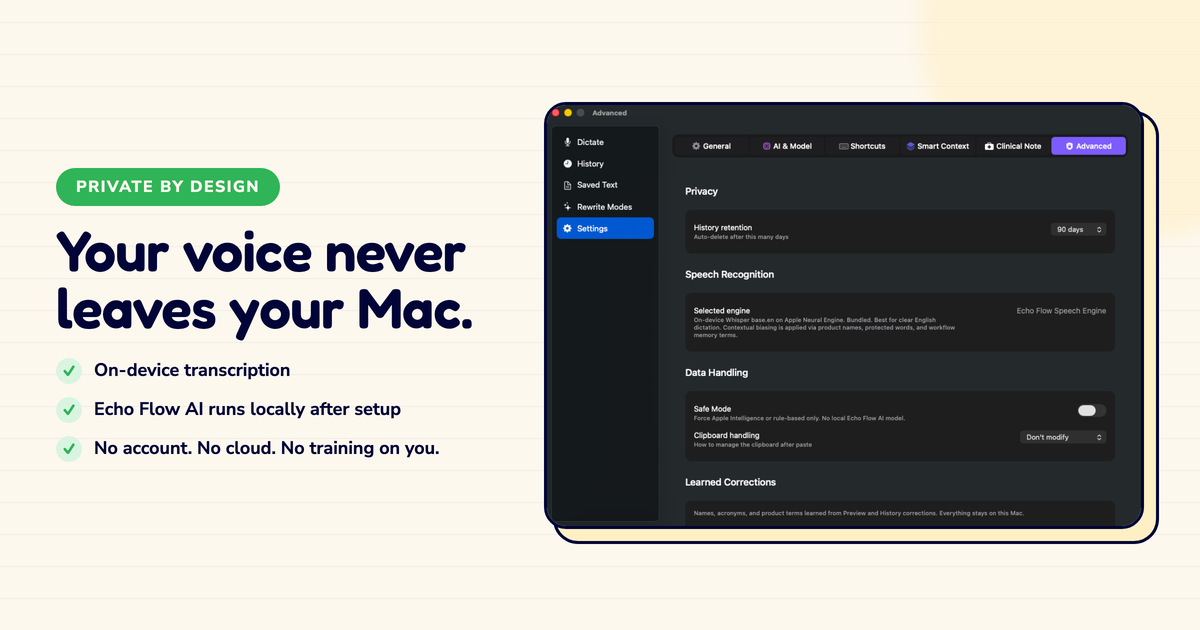
The Anti-Subscription Case: Why Owning Your Writing Tool Matters
This is the capstone argument. Not just about Echo Flow , about owning the tools you use to think and write.
I've been building toward this argument for the entire blog. Every post about privacy, about polish, about context-aware dictation , they all point here.
The tools you use to write are not like other software. They hold your thoughts. Your drafts. Your half-formed ideas. Your most unfiltered words.
And you should own them.
The argument in one paragraph
When you subscribe to a writing tool, you're renting access to your own thoughts. The company can raise prices, change features, shut down, or get acquired. Your drafts live on their servers, under their control. When you own the tool, none of that can happen. Your thoughts stay yours.
That's the whole argument. Everything else is elaboration.
1
Reason to own your writing tool: your thoughts should stay yours
The deeper problem
Here's what bothers me about subscription writing tools: they create a power imbalance.
You depend on the tool. You've built your workflow around it. Your drafts live in it. And the company knows this.
So they raise prices. You pay, because switching is painful.
They change features. You adapt, because your drafts are locked in.
They get acquired. You hope the new owner keeps the tool alive, because your workflow depends on it.
You're not a customer. You're a hostage.
I've been there. I've paid price increases I hated. I've adapted to feature changes I didn't want. I've hoped acquisitions would go well. Because my drafts were locked in, and switching was painful.
The ownership alternative
When you own your writing tool, the power imbalance disappears.
No price increases. You paid $69. You pay $69 forever.
No forced feature changes. The tool works the way it worked when you bought it.
No acquisition risk. There's no company to acquire. You own the tool outright.
No lock-in. Your drafts are on your Mac, in open formats. You can leave anytime.
I'm not arguing that ownership is always better. I'm arguing that for writing tools , tools that hold your thoughts , ownership is the sane default.
Subscription writing tools
Rent access to your thoughts
- Continuous updates
- Cloud features
- Your drafts on their servers
- Price can increase
- You're locked in
Owned writing tools
Own your thoughts
- Your drafts on your Mac
- No price increases
- No forced changes
- No lock-in
- Fewer cloud features
The shift I'm watching
Here's the trend I'm seeing: people are shifting from subscription to ownership for their core tools.
Not for everything. Cloud storage, email hosting, streaming , those make sense as subscriptions.
But for the tools you use to think and write? People are choosing ownership. They're buying one-time purchases. They're using local-first tools. They're getting out of the subscription trap.
I'm one of them. I went from $87/month in productivity subscriptions to $12/month. The rest are one-time purchases or free tools. I own my writing tools now.
The honest note
This isn't an argument against all subscriptions. It's an argument that writing tools are different. They hold your thoughts. Your drafts. Your most unfiltered words. Those should stay yours , on your hardware, under your control, owned outright.
The bottom line
You wouldn't rent a desk and then be told the rent is going up. You wouldn't rent a notebook and then be told the company is shutting down.
Your writing tool is the digital equivalent of a desk and notebook. Own it.
That's the anti-subscription case. Not about money , about owning the tools you use to think.
Get Echo Flow for $69 once · Why lifetime license · What if the company disappears
Sources
- Writer's own experience: subscription writing tools and the shift to ownership.
- Echo Flow architecture: local app, owned outright, no subscription.
- Industry trend toward local-first tools: local-first, owned productivity tools.