
Rewrite Palette · 7 min read
Why Rewriting in Place Beats Copying to a Chat Box and Back
I timed myself editing with a chatbot vs. editing in place. The difference was embarrassing.
I was editing a client email. I copied it to a chatbot, typed "make this more professional," waited for the response, read it, copied it back, pasted it over the original.
Total time: 47 seconds. For one sentence.
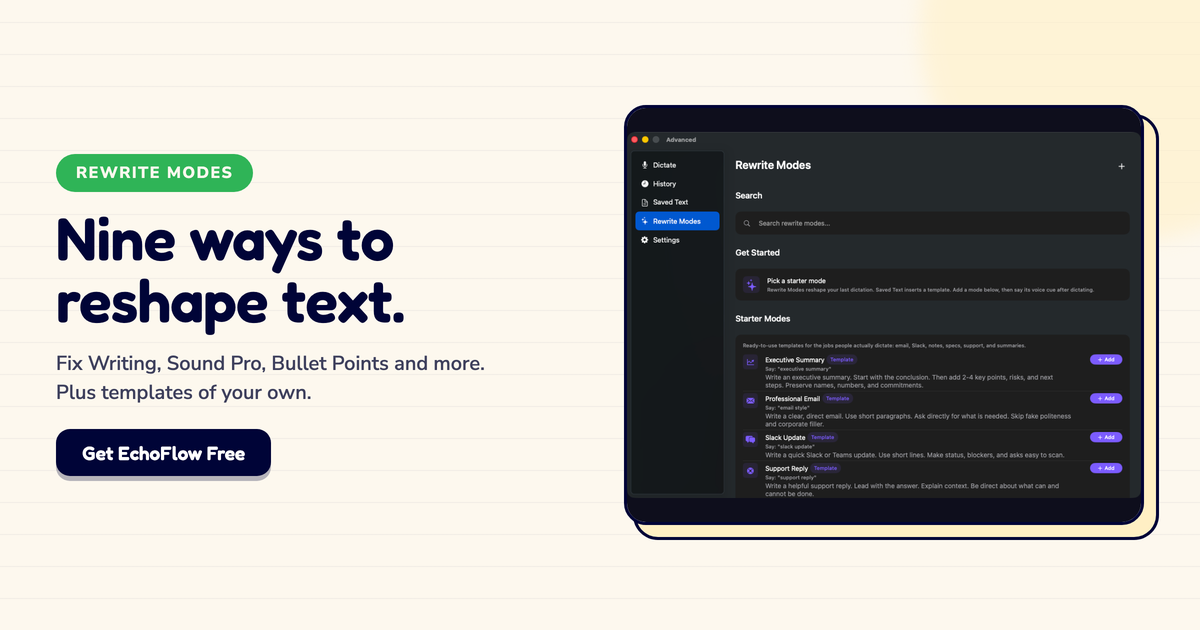
Then I tried selecting the same sentence, clicking "Sound Pro," and watching it replace in place.
Total time: 3 seconds.
That was the day I stopped using chatbots for editing.
Defenders of the chatbot model will say it's faster than I'm making it sound. And they're partly right , the AI responds quickly.
The time you notice is not the AI's response time. The time you notice is everything around it.
You had a draft open. You switched to another app, or opened a sidebar, or opened a browser tab. Now your draft is somewhere behind the AI tool, out of focus. When the polished text arrives, you have to carry it back to where you were.
That switch costs attention. You were composing a thought; now you are managing a workflow. And managing a workflow is the exact thing you were trying to avoid by using AI in the first place.
Here's what nobody talks about: context switching has an attention tax.
You're writing an email. You switch to a chatbot. Now you're in a different app, with a different interface, different mental mode. When you switch back to your email, it takes a moment to remember where you were.
That moment adds up. I tracked it: each context switch cost me 10-15 seconds of "wait, what was I saying?" time.
With 20 edits per day, that's 3-5 minutes of pure reorientation. Not editing. Not writing. Just remembering what I was doing.
In-place rewriting has zero context-switch cost. You select, click, continue. Your train of thought never stops.
Here's the part that should stop you: when you paste text into a chatbot, it leaves your device.
That client email with the customer's name? Now it's on a server. That internal strategy note? Now it's in someone else's training data. That medical dictation? Now it's a privacy incident.
I stopped pasting client work into chatbots after I read the privacy policies. Most cloud AI services reserve the right to use your inputs for training. Your drafts become their data.
In-place rewriting never leaves your device. The text stays local. The processing stays local. The privacy stays intact.
I still use chatbots. For brainstorming, exploring ideas, comparing angles , anything where I don't know what I want to say yet. Chatbots are great for that.
But for editing , when I know what I want and just want it said better , in-place rewriting is faster, more private, and less mentally taxing.
The mistake I made for months was using chatbots for both. Exploration and execution. Now I use chatbots for exploration and in-place rewriting for execution.
If you edit more than 5 times a day , and most of us edit 20+ times , the context-switch tax is real. Try in-place rewriting for a week. Track your time. I did. I'm not going back to the chatbot round-trip for routine edits.
Chatbots are great for thinking. In-place rewriting is faster for editing. The 44-second difference per edit adds up to hours per week.
Use chatbots when you're exploring. Use in-place rewriting when you're executing. That's the split that works.
Try Echo Flow free for 14 days · See the rewrite palette · Why the rewrite palette stays free
Sources